
Costa Rica at a glance
San José is the capital, about 5.2 million people live here, and the country is roughly four fifths the size of West Virginia. Below, each fact and where you can see it on a trip.
Last reviewed by our team in Costa Rica: . By The My Costa Rica team in San José.
Quick facts
- CapitalSan José, since 1823.
- Population5,191,823, the national statistics institute’s (INEC) projection for 30 June 2025.
- Size51,100 km², about 19,730 square miles.
- LanguageSpanish, official under article 76 of the Constitution.
- Currencythe colón. US dollars are also widely accepted.
- Time zoneUTC minus 6 all year, with no daylight saving.
- Provincesseven. San José, Alajuela, Cartago, Heredia, Guanacaste, Puntarenas and Limón.
- National symbolsthe flag, the Guaria Morada orchid, the Guanacaste tree, the yigüirro and both sloths, among 21 in all.
San José: the capital, and where many trips begin
San José has been the capital since 1823. Before that it was Cartago, the old colonial capital, and the change came after a battle at Ochomogo on 5 April 1823 and a decree of Congress moving the capital to San José. The city itself is younger than you might expect. The tourism board dates it to a chapel built in 1737 and consecrated in 1738; Britannica says it was settled in 1736.
It sits in the Central Valley at about 1,160 metres (3,800 feet). The canton of San José had 352,381 people in INEC’s 2022 estimate, and the whole province 1,601,167, so be careful with any “population of San José” you read: most of them are quoting the province.
For a visitor, two buildings are worth the stop. The National Theatre has been one of the country’s official national symbols since 2018. The National Museum fills the old Bellavista barracks, where the army was abolished in 1948, a story we tell on our history and government page.

Most of our trips that land at San José head out the same day. When the first stop is Arenal, we put La Paz Waterfall Gardens on that first day, because it is on the road and turns a transfer into part of the trip. More on the region in our Central Valley guide.
How big is Costa Rica?
51,100 square kilometres, or about 19,730 square miles. You will often read that it is “the size of West Virginia”. It is smaller than that: West Virginia covers 62,756 km², so Costa Rica is about four fifths of it.
Small is the point, for a trip. On our own itineraries Liberia airport to Arenal is about 3 hours, and Liberia to Tamarindo beach about 2, so a week can hold a volcano, a rainforest and a beach.
The coastline is where the sources part ways, and we show all three versions rather than pick one:
| Source | Pacific coast | Caribbean coast |
|---|---|---|
| Britannica | 1,015 km (630 miles) | 300 km (185 miles) |
| Costa Rica’s environment ministry (MINAE, State of the Environment report) | 1,660 km | 212 km |
| Widely repeated online, including our own older page | 1,016 km | 212 km |
The ministry adds that the total is more than 1,800 km. We could not find the third version on any official page.
The highest point is Cerro Chirripó, and again the figure depends on who you ask: 3,820 metres according to SINAC, the national parks service that runs it, 3,819 metres (12,530 feet) in Britannica, and 3,821 metres in a May 2026 country file from Spain’s foreign ministry. See Chirripó National Park.

Far offshore is Cocos Island, a national park of 24 km² in the Pacific. SINAC gives its distance as 532 km from Cabo Blanco in one document and 535 km on its own conservation-area page; another government report says about 500 km from the mainland. In December 2015 the International Court of Justice also confirmed Costa Rica’s sovereignty over the disputed northern part of Isla Portillos, in a case brought against Nicaragua.
Seven provinces, and which airport opens which
Costa Rica has seven provinces: San José, Alajuela, Cartago, Heredia, Guanacaste, Puntarenas and Limón. The territorial division law lists 84 cantons under them.
For planning, the airport you fly into matters more than the province lines. Liberia, in Guanacaste, opens the northwest Pacific beaches and their resorts. San José is the gateway to Manuel Antonio and the wild Osa Peninsula. Our Costa Rica map shows how the regions fit together, and our guide to where to go takes it region by region.
Who lives in Costa Rica?
INEC, the national statistics institute, projects 5,191,823 people at 30 June 2025. Its 2022 estimate was 5,044,197. Britannica’s 2026 estimate is higher, 5,343,000, and is not an INEC number.
In the 2011 census, the most recent with these questions answered, 83.6% of people identified as white or mestizo, 6.7% as mulatto, 2.4% as Indigenous and 1.1% as Black or Afro-descendant. Eight Indigenous peoples live in 24 territories: Cabécar, Bribri, Boruca, Ngäbe, Huetar, Maleku, Térraba and Chorotega. The same census counted 9.0% of residents born abroad, about three quarters of them in Nicaragua.
Life expectancy at birth was 80.9 years in 2024, INEC’s observed figure.
Religion is the number that moves most. A National University (UNA) survey in October 2024 found 50% of people identify as Catholic and 33% as Evangelical; press reports of the same survey give 49.8% and 30.8%. A 2026 country file from Spain’s foreign ministry still says 76.3% Catholic, with no source or year. Either way, Holy Week is the busiest week of the year here.
Spanish is the language you will hear. Our pages on language, culture and religion go further.
What does the Costa Rican flag mean?
The blue, white and red flag dates from 29 September 1848. Tradition credits its design to Pacífica Fernández Oreamuno, wife of José María Castro Madriz, who led the country at the time, and it was inspired by the flag of France.
The meanings, as the national printing office’s 2025 guide to the symbols gives them:
- Blue is the sky that covers Costa Rica like a protective cloak.
- White is the peace the country lives in, and the purity of its ideals.
- Red is the energy, courage and generosity with which Costa Ricans defend their principles.
The coat of arms shows three volcanoes between two oceans, with merchant ships. Its seven stars stand for the seven provinces: there were five until 21 October 1964, and the volcanoes were given their smoke in 1998.
The national anthem, “Noble patria, tu hermosa bandera”, is about the flag. The same 2025 guide says Manuel María Gutiérrez wrote the music in 1852; our own older page said 1853, which you will still see quoted. José María Zeledón’s lyrics were first sung on 15 September 1903 and made official in 1949.

The Guaria Morada, the national flower
The Guaria Morada, a purple orchid, was declared the national flower on 15 June 1939. The national printing office still lists it as Cattleya skinneri.
The University of Costa Rica says it bursts into flower every year between March and April, and March is also National Orchid Week. That is when to see it at its best.
The place to go is the Lankester Botanical Garden in Dulce Nombre, Cartago. It began as Charles Lankester’s private garden and passed to the University of Costa Rica on 2 March 1973. It opens every day from 8:30 a.m. to 4:30 p.m., and there is an entrance fee. The national orchid show has been held there each March since 2022; the 51st edition ran from 12 to 15 March 2026.

National symbols you can see on a trip
Costa Rica has 21 official national symbols, according to the national printing office’s 2025 guide. An older Legislative Assembly document says 13. The ones a visitor actually meets:
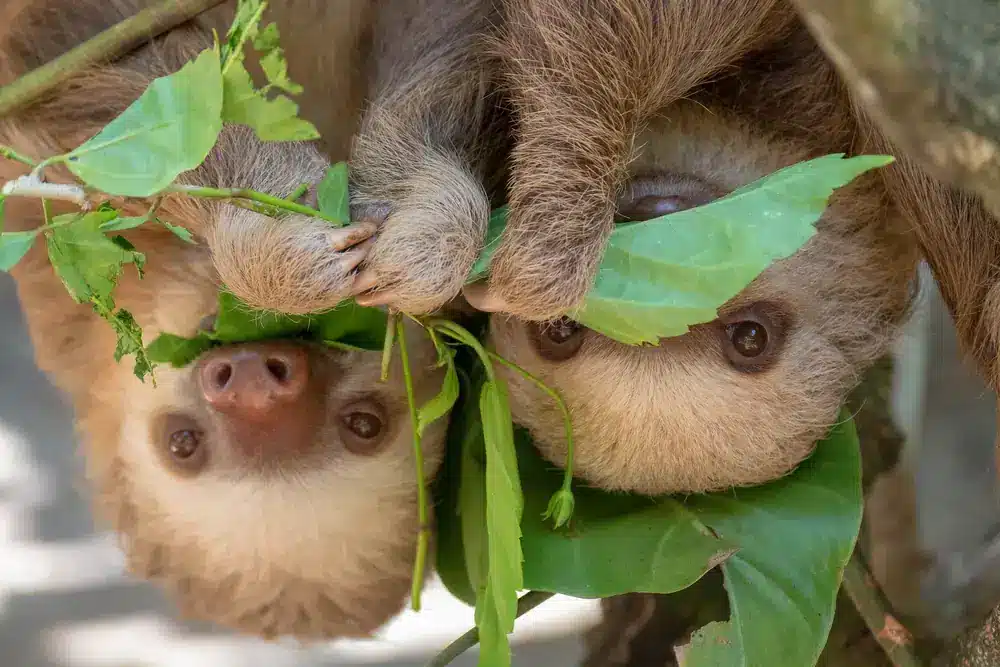
- Sloths. Both the two-toed and the three-toed sloth became national symbols in 2021. See our guide to sloths.
- The yigüirro, the national bird since 1977 (the Costa Rican embassy in Washington says 1976), a thrush, Turdus grayi.
- The white-tailed deer, symbol of the country’s wildlife since 1995.
- The Guanacaste tree, the national tree since 1959.
- The painted oxcart, a national symbol since 1988. UNESCO recognised the oxcart and oxherding tradition in 2005.
- The stone spheres of the Diquís, since 2014. Where to see them is on our history page.
The newest additions include the morpho butterfly (2022), the hummingbirds (2024) and the adobe and bahareque house (2025). The marimba has been the national instrument since 1996, and coffee a national symbol since 2020. For birds and animals by region, start with our animals guide.
Sources we checked on 1 November 2026
- INEC, the national statistics institute: Costa Rica en cifras 2025
- Imprenta Nacional: Símbolos nacionales 2025
- Political Constitution of Costa Rica (Imprenta Nacional edition)
- Office of the President: national symbols
- SINAC: Chirripó National Park
- University of Costa Rica: Lankester Botanical Garden
- US Census Bureau: state areas
- Britannica: Costa Rica
Costa Rica facts: common questions
What is the capital of Costa Rica?
San José, since 1823, when the capital moved from Cartago. It sits in the Central Valley at about 1,160 metres, and many of our trips that land there head straight out to Arenal or the coast.
What is the population of Costa Rica?
About 5.2 million. The national statistics institute, INEC, projects 5,191,823 people at 30 June 2025. Its 2022 estimate was 5,044,197.
What do the colours of the Costa Rican flag mean?
According to the national printing office’s 2025 guide, blue is the sky that protects the country, white is peace and the purity of its ideals, and red is the energy, courage and generosity with which Costa Ricans defend their principles. The flag dates from 29 September 1848.
How big is Costa Rica?
51,100 square kilometres, or about 19,730 square miles. That is about four fifths the size of West Virginia, not the same size, as is often said.
What is the national flower of Costa Rica?
The Guaria Morada, a purple orchid, declared the national flower on 15 June 1939. It flowers between March and April, and you can see it at the Lankester Botanical Garden in Cartago.
What is the national animal of Costa Rica?
There are several. The white-tailed deer has been the symbol of the country’s wildlife since 1995, both sloths became national symbols in 2021, and the national bird is the yigüirro, a thrush.
What currency does Costa Rica use?
The colón. US dollars are also widely accepted, according to the tourism board.
What time zone is Costa Rica in?
UTC minus 6 all year, with no daylight saving. That is the same time as Chicago in the northern winter and as Denver in the summer.
More from our travel guides
Plan your Costa Rica with a team that lives here
My Costa Rica is a destination management company based in Costa Rica since 2004. We contract directly with hotels, drivers and guides, so every trip is built by people who live here and supported by our own team 24/7 while you travel.